

Operating fire trucks in mountainous areas presents a unique set of challenges and requires specialized strategies and equipment. As a fire truck supplier, I have witnessed firsthand the importance of tailoring fire - fighting solutions to the specific demands of mountainous terrains.
Challenges in Mountainous Areas
Mountainous regions are characterized by steep slopes, narrow and winding roads, limited access to water sources, and difficult terrain. These factors can significantly impede the operation of fire trucks.
Steep slopes pose a major challenge for fire trucks. When climbing uphill, the engine has to work harder to overcome gravity, which can lead to overheating if the vehicle is not properly equipped. On the other hand, descending steep slopes requires careful braking to prevent the truck from gaining excessive speed and losing control. The weight distribution of the fire truck also becomes crucial on slopes. A poorly balanced truck may tip over, especially when making sharp turns on inclined roads.
Narrow and winding roads in mountainous areas limit the maneuverability of fire trucks. Fire trucks are large vehicles, and it can be extremely difficult to navigate through tight curves and narrow passages. There may also be low - hanging branches, rocks, or other obstacles that can damage the truck or block its path. In some cases, the roads may be so narrow that only one vehicle can pass at a time, which can cause delays in reaching the fire scene.
Access to water is another critical issue. Mountainous areas often lack a reliable network of hydrants or large water bodies. Firefighters may have to rely on natural water sources such as rivers, lakes, or streams. However, these sources may be located far from the fire, and the water may need to be pumped over long distances and up steep inclines. This requires powerful pumps and long - length hoses.

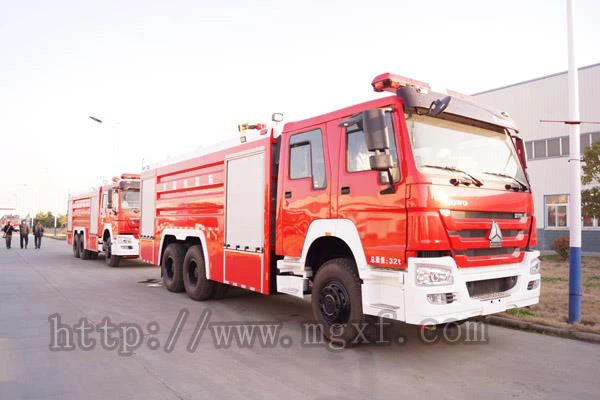
Specialized Equipment for Mountainous Operations
To address these challenges, fire trucks used in mountainous areas need to be equipped with specialized features.
First, they should have powerful engines with high torque. A high - torque engine can provide the necessary power to climb steep slopes without overheating. Turbo - charged engines are often a good choice as they can deliver more power in high - altitude and low - oxygen environments, which are common in mountainous regions.
Four - wheel drive (4WD) or all - wheel drive (AWD) systems are essential for better traction on rough and slippery mountain roads. These systems allow all four wheels to receive power simultaneously, improving the truck's ability to navigate through mud, snow, and uneven terrain. Additionally, trucks should be equipped with large - diameter tires with deep treads to enhance grip on loose surfaces.
For water supply, fire trucks need powerful pumps. Centrifugal pumps are commonly used, but in mountainous areas, positive - displacement pumps may be more suitable for pumping water over long distances and up steep slopes. These pumps can maintain a consistent flow rate regardless of the pressure changes caused by elevation differences.
In terms of capacity, different models of fire trucks can be selected according to the specific needs of the mountainous area. For example, the 16000L Foam Tank Fire Truck offers a large capacity of foam, which can be very effective in extinguishing wildfires in mountainous forests. The 25000L Water Foam Fire Truck provides a huge water supply, which is crucial when access to natural water sources is limited. And the 6000L Foam Tank Fire Truck is a more maneuverable option for areas with relatively narrow roads.
Operational Strategies
In addition to specialized equipment, operational strategies also play a vital role in mountainous fire - fighting.
Pre - incident planning is essential. Fire departments should conduct detailed surveys of the mountainous areas they are responsible for. This includes mapping out the location of water sources, identifying the most accessible roads, and noting potential hazards such as unstable slopes or areas prone to rockfalls. By having a clear understanding of the terrain, firefighters can develop more effective response plans.
When responding to a fire, communication is key. Firefighters need to stay in constant contact with each other and with the command center. This can be challenging in mountainous areas due to poor signal reception. To overcome this, fire trucks can be equipped with satellite communication systems or high - powered radio repeaters.
Once at the fire scene, firefighters need to establish a safe and efficient water supply. If using a natural water source, they should first assess the water quality and make sure it is suitable for use. They may need to set up intake screens to prevent debris from entering the pump. Multiple pumps can be used in series to increase the pumping capacity and reach greater distances.
Training for Firefighters
Firefighters operating in mountainous areas require specialized training. They need to be familiar with the operation of the specialized equipment on the fire trucks. For example, they should know how to properly use the high - torque engine, 4WD system, and powerful pumps.
Training also includes navigation skills. Firefighters should be trained to read topographical maps and use GPS systems to find their way through the mountains. They need to understand the rules of driving on mountain roads, such as how to approach curves, how to deal with steep slopes, and how to park safely on inclined surfaces.
In addition, firefighters need to be trained in water - sourcing techniques. They should know how to locate natural water sources, how to set up pumping systems, and how to maintain a continuous water supply. They also need to be aware of the potential risks associated with working near water, such as flash floods or strong currents.
Our Role as a Fire Truck Supplier
As a fire truck supplier, we understand the unique requirements of fire - fighting in mountainous areas. We offer a range of fire trucks that are specifically designed to meet these needs. Our trucks are equipped with high - performance engines, 4WD systems, and powerful pumps. We also provide customization options, so that the trucks can be tailored to the specific needs of different mountainous regions.
We work closely with fire departments to ensure that they receive the best possible support. We offer training programs for firefighters on the operation of our trucks. Our technical support team is available 24/7 to provide assistance in case of any equipment problems.
If you are responsible for fire - fighting in a mountainous area, we invite you to contact us for a detailed discussion on your requirements. Our experienced sales team can help you select the most suitable fire truck model and provide you with a customized solution. We are committed to providing high - quality fire trucks and excellent after - sales service to ensure the safety and effectiveness of your fire - fighting operations.
References
- "Firefighting in Mountainous Terrain: Challenges and Solutions" - International Fire Service Training Association
- "Specialized Fire Trucks for Remote and Difficult Terrains" - Fire Equipment Manufacturers' Association
- "Training Guidelines for Mountain Firefighters" - National Wildfire Coordinating Group


